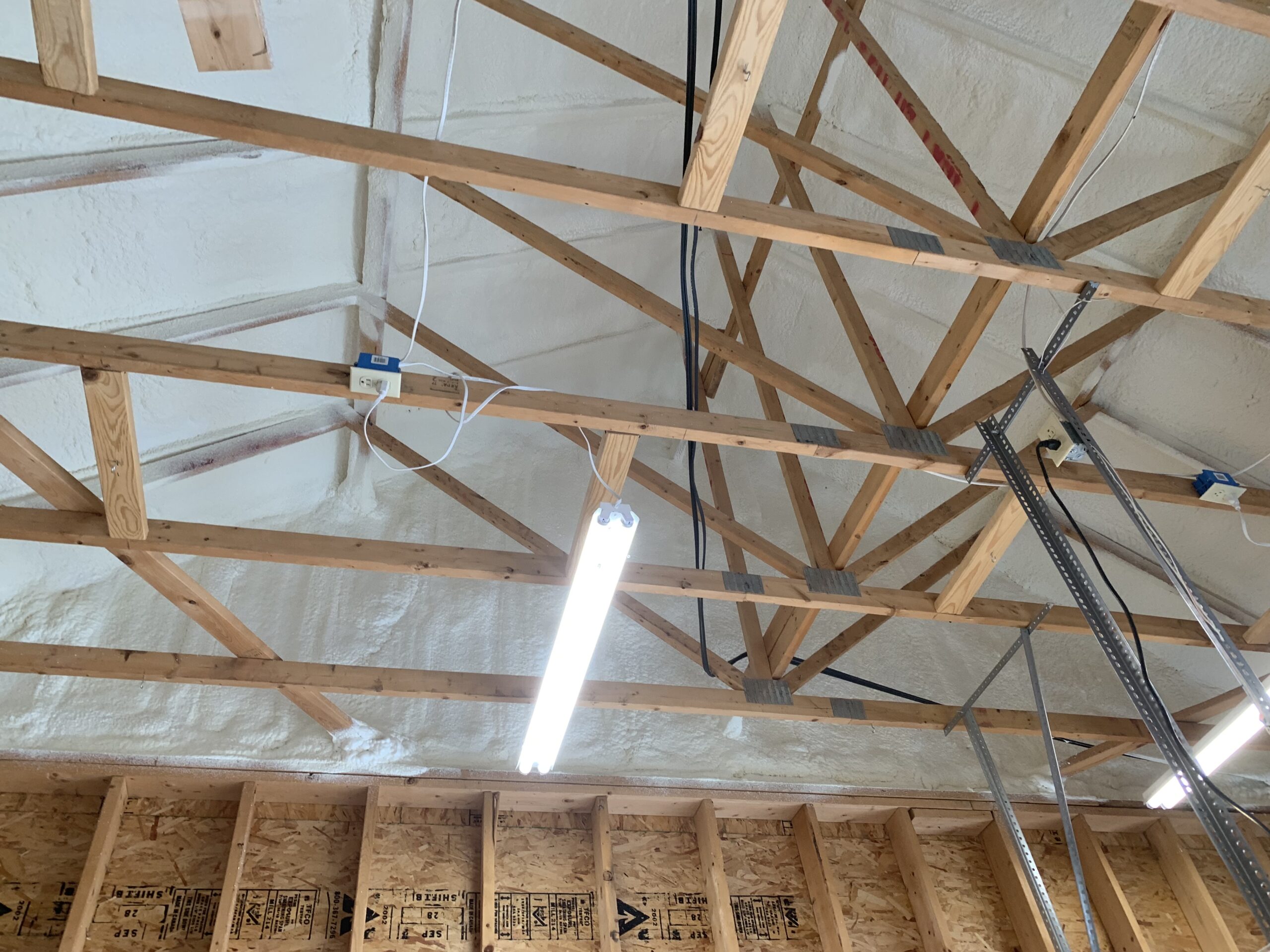
If you’re researching metal building insulation in Des Moines, IA, the first goal is usually not “hit a certain R-value.” It’s to stop the building from sweating, drafting, and wasting heat. Condensation happens when warm, moist air hits a surface that’s at or below the dew point, and metal buildings are especially prone to that problem. The good news is that most metal building problems are predictable. When you treat the building as a system, air movement, moisture, and insulation working together, the space becomes usable year-round.
Why Do Metal Buildings “Sweat” So Much In Iowa?
Sweating is just condensation you can see. It’s not mysterious, just physics. Condensation occurs when warm, moist air contacts a surface that’s cold enough to reach the dew point in metal building systems, which can happen on roof panels, fasteners, or structural members.
Quick “is this condensation?” checklist
- Drips form on the underside of the roof during temperature swings
- Moisture shows up around fasteners or seams
- Tools rust faster than expected
- The building feels clammy even when it isn’t raining
Common mistake: Treating sweating like a “roof leak” and only sealing random seams. If the moisture is from condensation, you need to change the temperature and moisture conditions at the metal surface, usually by adding insulation, controlling air movement, and handling vapor correctly.
Local factor: Des Moines gets real seasonal swings. Condensation can show up in spring and fall, even if you barely heat the building, because daytime warmth meets cold night surfaces.
Decision rule: If the roof only “leaks” during temperature swings and not during rain, treat it as condensation until proven otherwise.
Where Should You Insulate First: Roof, Walls, Or Doors?
The right first step depends on how you use the building.
Heated shop or workspace
- The roof/ceiling is often priority #1 because it’s the biggest loss surface.
- Next, seal the big air leaks (overhead doors, end-wall corners).
- Then insulate walls to stabilize temperatures.
Storage-only building
- You may still need condensation control on the roof first to protect the contents.
- Wall insulation can be phased later.
Common mistake: Insulating walls while leaving the roof as a cold condensing surface. That can keep the building drafty and still allow sweating overhead.
Local factor: In Des Moines, wind-driven air leakage around doors and corners can undo a lot of insulation. Door seals and transitions matter more than most owners think.
Which Insulation Works Best For Metal Buildings?
Here’s a simple comparison. The “best” option depends on whether you’re fighting condensation, drafts, or just trying to control costs.
Option | Where it fits | Why owners choose it | Watch-outs / decision rule |
Closed-cell spray foam | Roof decks, walls needing moisture resistance | Strong air sealing + moisture resistance; good for condensation-prone assemblies (commonly recommended in practice) | Costs more; thickness and coverage must be consistent; discuss code requirements for barriers. |
Open-cell spray foam | Some interior walls where moisture exposure is low | Air sealing at a lower cost | Not the go-to choice for high moisture exposure—ask “why this foam here?” |
Fiberglass (blankets/batts) | Large areas with consistent cavities | Often lower upfront cost | Performance drops with air movement; needs clean detailing to avoid moist air reaching cold metal. |
Hybrid (foam + fiberglass) | Budget-conscious projects | Foam seals key transitions; fiberglass adds depth | Requires a clear scope so you don’t end up with gaps and cold stripes |
Decision rule: If condensation is your main complaint, prioritize a system that controls air movement and keeps moist interior air off cold metal surfaces.
What Does A Quality Insulation Project Look Like Step-By-Step?
A real metal building insulation in Des Moines, IA, project has a repeatable process. If a contractor can’t describe their steps, that’s a red flag.
- Assessment (use-case + moisture mapping): The contractor asks how you use the building (heated shop, storage, office, warehouse) and checks where condensation or drafts appear.
- Air leakage plan (doors, seams, penetrations): Before insulation, they identify the big leaks that will ruin performance.
- Material selection tied to the problem: They explain why foam vs fiberglass in that exact location, based on moisture risk and access.
- Prep + protection: Equipment gets covered. Sensitive items are moved. Work zones are defined.
- Ventilation and isolation during spray foam application (if used): EPA’s ventilation guidance describes principles like establishing airflow across the spray area, isolating the work area, exhausting to a safe location, and ensuring adequate ventilation following application.
- Installation with thickness/coverage checks: This is where good work shows up: consistent depth, no missed corners, no thin edges.
- Code and barrier discussion: Foam plastic insulation often must be separated from the interior by an approved thermal barrier (commonly 1/2-inch gypsum) per IRC R316.4, depending on the application and use. A good contractor explains what applies to your building and why.
- Verification walkthrough: You should get a clear “before/after” explanation and what to watch for next season.
What Mistakes Cause Condensation & Waste Money?
Mistake #1: Insulating without controlling air movement
Fiberglass can insulate, but if air flows through gaps and seams, warm, moist air can still reach cold metal.
Mistake #2: Ignoring the overhead door and corners
If the building is drafty around the big door, your heater is battling infiltration all winter.
Mistake #3: Skipping ventilation planning for spray foam
Ventilation is not optional during SPF application. EPA publishes clear guidance for a reason.
Mistake #4: No plan for required barriers
A proposal should address thermal/ignition barriers when they apply.
Local factor: A metal building in Des Moines may be used seasonally. The first time you heat it after months of cold, condensation can show up fast if the insulation strategy is incomplete.
What Affects Cost And Timeline In Des Moines, Ia?
Prices depend on building conditions, not just square footage. Here are the real drivers:
- Building size and height: Lifts and access time
- Roof complexity: Seams, penetrations, transitions
- How “full” the building is: More prep/protection time
- Material choice: Spray foam vs fiberglass vs hybrid
- Door and air leakage scope: Sealing big leaks improves outcomes, but adds labor
- Barrier requirements: Gypsum or approved coatings can add scope
- Schedule needs: Working around business operations can change the timeline
Decision rule: If you’re trying to control costs, ask for a phased plan: roof strategy first (condensation), then walls, then detail upgrades.
Conclusion
A metal building doesn’t have to be a “three-season” space. If you solve condensation and air leakage first, the insulation actually gets a chance to work. The best projects start with a clear plan, pick materials based on moisture risk and building use, and finish with verification, so you’re not chasing drips and drafts every year. For metal building insulation in Des Moines, IA, contact Precision Insulation & Coatings to map the right scope for your building and your budget.
FAQs
What causes a metal building to sweat?
Condensation forms when warm, moist air contacts a surface that’s at or below the dew point. Metal surfaces change temperature quickly, so they’re prone to this.
Is spray foam good for metal buildings in Des Moines?
It can be, especially for condensation and air leakage problems. Closed-cell foam is often chosen for its moisture resistance and air sealing performance in these assemblies.
Is fiberglass okay in a metal building?
Yes, in the right system. The key is detail work, limiting air movement, and managing vapor so moist air doesn’t reach cold metal surfaces.
Do I need a vapor barrier?
Sometimes. The answer depends on your assembly, indoor humidity, and insulation choice. A contractor should explain where vapor control belongs in your specific building.
Is ventilation required during spray foam installation?
Yes. EPA ventilation guidance exists to protect workers and occupants during and after spraying.
Does spray foam need drywall or a thermal barrier?
In many cases, foam plastic insulation must be separated from the interior by an approved thermal barrier such as 1/2-inch gypsum (IRC R316.4), unless an exception applies.
Should I insulate the roof or walls first?
If condensation is the main issue, start with the roof strategy. If comfort and drafts are the main issue, roof plus door leakage usually comes first.
How do I choose a Metal Building Insulation in Contractor, Iowa?
Ask for a written scope: what surfaces, what material, thickness targets, ventilation plan (if spraying), and how they’ll verify coverage and address barrier requirements.