If you’ve ever walked across a living room floor in January and felt it “bite” through your socks, you already understand the problem: a basement doesn’t just make the space below cold and damp; it can drag down comfort in the rooms above it, too.
In Iowa, that problem gets amplified. We deal with long heating seasons, big temperature swings, and basements that love to hold onto humidity. That’s why closed-cell spray foam is such a strong option for basement ceiling insulation (and especially the rim-joist area where the house meets the foundation). It doesn’t just add R-value. It also air-seals, helps control moisture movement, and cuts down on the drafts that make your main floor feel chilly.
At Precision Insulation & Coatings, we install closed-cell spray foam across Central Iowa because it solves the real issues homeowners feel every day: cold floors, musty smells, and heating bills that never seem to calm down.
What “Basement Ceiling Insulation” Really Does
When people say “insulate the basement,” they might mean one of two things:
- Insulate the basement ceiling (the underside of the first-floor framing)
- Insulate the basement walls and treat the basement as part of the home’s conditioned space
This article is focused on basement ceilings, a common choice when:
- The basement is unfinished and stays unheated.
- You want warmer floors upstairs.
- You’re trying to quiet the sound between levels (laundry room noise, mechanicals, footsteps).
But here’s the key: insulating the basement ceiling works best when you also air-seal the biggest leak zones, especially the rim joist. The U.S. Department of Energy has guidance focused on rim-joist air sealing because that area is a major pathway for air leakage.
Why Iowa Basements Are Tough on Traditional Insulation
Basements create a perfect storm for comfort problems:
1) Stack effect pulls basement air upward
In winter, warm air rises and escapes from upper levels. That pulls replacement air in from lower areas, including the basement, through gaps you can’t see. If your basement ceiling has fiberglass batts with gaps, missing vapor control, or air leakage around plumbing/wiring, the basement air doesn’t stay in the basement. It migrates.
2) The rim joist is a draft factory
That band of wood at the top of your foundation (rim/band joist area) is one of the leakiest zones in many homes. DOE and ENERGY STAR building-science resources treat it as a priority seal location because it’s where air sealing needs to be continuous from foundation to framing.
3) Moisture moves through air first, materials second
Most moisture problems aren’t from water “soaking through” insulation; they’re from humid air leaking into cold surfaces and condensing. That’s why air sealing matters as much as R-value.
What Makes Closed-Cell Spray Foam Different
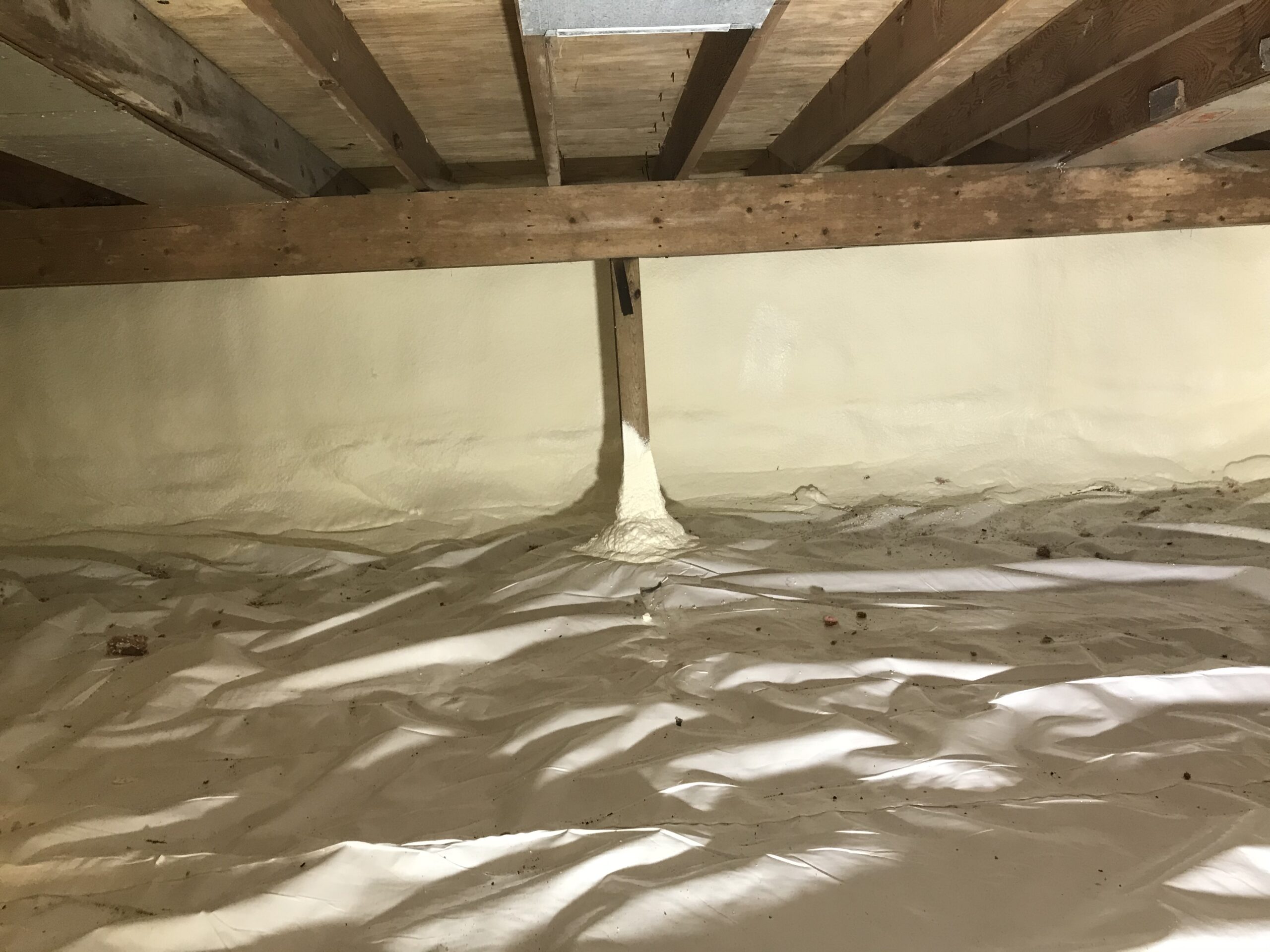
Closed-cell spray foam is dense. It expands to seal cracks, then cures into a rigid insulation layer that resists air movement. Here’s why that matters on Iowa basement ceilings:
Closed-cell foam acts like insulation + air seal in one step
Fiberglass batts can be R-value on paper, but they don’t stop air leakage. Closed-cell foam fills and seals the edges, penetrations, seams, and framing irregularities that let cold air roll through the floor system.
That’s not marketing; building-science resources repeatedly call out closed-cell spray foam for its ability to align the air barrier and thermal barrier in tricky locations.
It helps control vapor movement.
Closed-cell foam can function as a vapor retarder at certain thicknesses (your installer should confirm based on the product and assembly). Precision Insulation & Coatings also explains this plainly: closed-cell foam can act as a vapor barrier at specific thickness ranges while still resisting moisture.
It’s a strong match for cold-climate realities.
Iowa sits in colder IECC climate zones (commonly zones 5 and 6, depending on the county). That means wintertime temperature differences are intense, and that’s when condensation risk jumps if warm, moist indoor air reaches cold surfaces.
Closed-cell foam’s air sealing helps reduce that risk because it limits the airflow that carries moisture.
The Big Win: Rim Joists + Basement Ceilings Together
If you only remember one thing from this blog, make it this:
A basement ceiling is only as good as its air seal, especially at the rim joist.
ENERGY STAR/Building America resources describe the “critical seal” concept: for an effective air barrier, foam needs to connect the foundation wall to the rim joist and up to the floor above. That’s one reason closed-cell spray foam shines here. It can create a continuous, adhered seal where cut-and-cobbled foam boards or batts often end up with gaps.
At Precision Insulation & Coatings, we see it all the time: homeowners have insulation up there already, but they still feel drafts because the leak points were never actually sealed.
What About Radon in Iowa?
Radon is a real concern across Iowa, and the EPA emphasizes that radon testing matters no matter where you live.
Closed-cell spray foam is not a replacement for a radon mitigation system. But tightening up air leakage pathways can be part of an overall strategy in a home that’s being improved. The right move is:
- Test your home.
- If elevated, mitigate with a professional system.
- Then improve air sealing/insulation so the home performs better.
(And yes, even if you air seal, still test. Always.)
Comfort Benefits You’ll Actually Notice
Here’s what homeowners typically feel when closed-cell spray foam is done right on a basement ceiling (and rim joist):
- Warmer floors on the main level during Iowa winters
- Fewer drafts around baseboards and first-floor rooms
- More stable indoor temps, so the furnace cycles less aggressively
- Less “basement smell” creeping into the living space
- Better protection for plumbing lines that run through the floor system (because cold air isn’t washing over them)
The Bottom Line for Iowa Basement Ceilings
Closed-cell spray foam works so well on Iowa basement ceilings because it tackles the biggest issues all at once:
- Air leakage (drafts + stack effect)
- Moisture transport (humid air reaching cold surfaces)
- Thermal performance (steady comfort upstairs)
If you want a basement ceiling that actually performs, not just “has insulation in it,” closed-cell spray foam is one of the most reliable solutions available.
If you’re in Central Iowa and want to talk through your options, Precision Insulation & Coatings can look at your basement layout, identify the real leak points, and recommend the right approach for your home.
Frequently Asked Questions We Hear from Iowa Homes
Should I insulate the basement ceiling or the basement walls?
If your goal is warmer upstairs floors and the basement stays unconditioned, insulating the ceiling can make sense. If your goal is overall efficiency and you want the basement to be part of the conditioned envelope, insulating walls is often the stronger long-term approach (and can help with humidity control). A quick assessment from Precision Insulation & Coatings usually makes the best path obvious.
Can I just use fiberglass batts?
You can, but batts alone often underperform because they don’t air-seal. DOE guidance around rim-joist areas focuses heavily on air sealing continuity because gaps and penetrations are the real problem.
Does spray foam need a fire/thermal barrier?
Often, yes, foam plastics commonly require a thermal barrier (like 1/2″ gypsum) or an approved alternative depending on where and how they’re installed. Requirements vary by application and product approvals, so it needs to be handled correctly. This is another reason we recommend professional installation: you want performance and code-aligned protection.